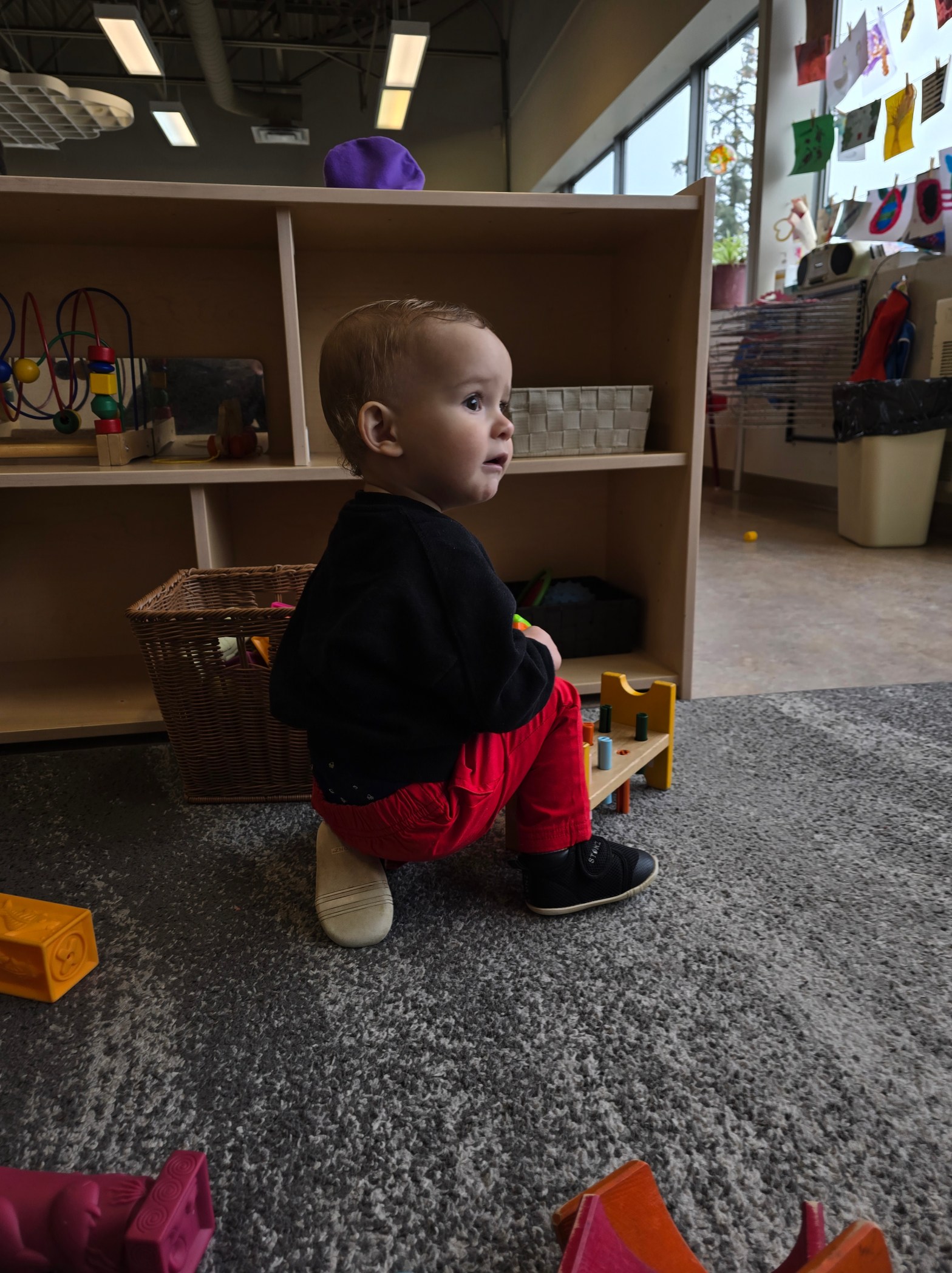
Thanks for showing up for my latest blog post! In this post, I will reveal to you a process of my own reflective practice, as I consider the ways I am showing up and coming across in early years spaces. I will reflect on anti-Black racism, and speculate on how it might be showing up in a specific situation. I also reflect upon how, given my very obvious white body – how I might more responsibly and more responsively navigate early years spaces.
Situating myself on my journey as a white ECE
I am a white multi-generational Southwestern Ontario settler who grew up in Sarnia, a small, predominately white city in Ontario. Most of my time as a direct service ECE was spent working in Toronto (specifically the north west quadrant of the city). Alongside the grind of just surviving as an ECE, and later a child care supervisor, has been a never-ending journey of reflective practice – of looking in the mirror at my own racism. Of feeling that racism come up in my body and in my emotional reactions, of seeing it in the very lens I’m looking through, of facing it for what it is, of examining it, of processing it – and the shameful feelings that come with it – which really is a never-ending process. I also have a wealth of queer femme and women of colour friends who are much more learned than me about issues of race relations and racism. They very generously, on occassion, (they do not have to do it, and unlike me they are forced to process a large burden of racism and other isms almost constantly already) hold that mirror for me – moving it out of my blankspots to where I can see – and for that I am truly grateful.
Last week at the EarlyON, as a parent
Last week, I went to an EarlyON centre with my very own 1 year old (and for the record, I don’t recommend waiting until your mid 40s to get a baby, this whole thing is very tiring). I am a parent now! (I’m a service-user!), alongside being an ECE professor, after decades of being an ECE in these spaces.
My baby is very active, so we headed to the gross motor stuff. That’s when I encountered a slim and energetic 3-year-old whom we will call Aden (not his actual name). As I approached the area adjacent to where Aden was playing with some waffle blocks, he appeared to me to get his back up, pushing a large structure over towards me. Scrunching up his face and clenching his little arms and legs, he jumped to his feet and landed in what seemed to me like a ‘protective’ kind of a stance.
Down on the carpet on my knees with my child, Sève, I looked in Aden’s direction and in a gentle and cheerful voice I said “Oh wow, look what you can build! That is so big, look at these big structures baby-Sève”. Perhaps reading me as a bit more welcoming, Aden did a few little show off jumps around his structure and I said something like, “Wow, nice jumping! You are having fun!”
Soon after, Aden’s mom appeared and knelt down with us, rubbing his little back. She looked at me and said, “You’re so kind to my son.” And I said “He seems like a real sweetheart.” She looked at him and said “Did you tell your friends your name? Say, “Hi I’m Aden.” (again, not his real name). Aden continued with his delightful jumping and jogging around us.
Then mom leaned towards me and said in a lower tone, “You know, since we’ve been here, not everyone is so nice to him.” Concerned, I said “Oh no?” and she said “No. Many times they are more…” she seemed discerning, perhaps trying to come up with a diplomatic way to say it.. “stern.. with my child, than they are with the others, and I do not understand why.” In my head I wondered if the reason Aden was being treated poorly was racism. Then I wondered if my impression of them as East African newcomers was correct. As I was wondering, 2 EarlyON staff, another mom and a few more children, entered the room.
I watched Aden’s mom and the additional 3 adults, one East Asian and two South Asian, engage with the handful of children in the room. It was an adorable, high-energy scene. Someone put on some music and next thing you know I was whisked away to that kind of EarlyON heaven that happens, where it seems like every single adult puts aside their stresses, comes into the present, and comes into their body, with the children of the community. One of the staff challenged me to a hula hoop contest and I could not seem to move my hips fast enough to keep it up, which everyone found funny. Someone suggested doing it around my neck and I was really good at that! We batted beachballs around and built tunnels out of foam blocks. Once in a while Aden would look up at me and do a cute little shimmy, which I eventually realized meant “do the hula hoop with your neck again.”
Eventually drop-in came to a close, and I strapped baby Sève into his carseat. I was thinking about how much I’ve grown. And about how I now need to grow….and how growing isn’t always about getting higher or bigger, but how it can be more like….coming back down, into a body, on this earth.
I reviewed snapshots of the morning – entering the room with Aden, how he seemed to feel a need to protect and defend upon first encountering Jess Woods, with their white skin and white ways. I wondered if his mom’s comment might have been re-worded as “Not every white person is so nice to us”. I’m not saying my perception of the situation was actually, for sure, what was happening – I can’t know and most likely won’t ever know. I’m just saying, I was using my reflective practice. I was thinking about the situation from different angles.
The most important part of this post
I’m ashamed to consider how, before I shed some of my racism and grew my understanding of the world – before I moved to Toronto, before I came to know and love Weston Village, and Little Jamaica, and Keelesdale, and Rexdale, and so on, my body/mind might have read that situation very differently. How I likely would have seen that three-year-old Black child as, not defensive, but – aggressive, hyper, or volatile. Which, I can see now, when I look back, used to make me act – even unconsciously – more boundaried and instructive with children like Aden, instead of just open, soft and gentle. Which – when coupled with my white skin – might have reinforced his need to protect himself and gotten his adrenaline going. And I can see how, if we were to carry on like that, as white ECE and Black child, how our relationship would be literally shaped and limited and corrupted by racism itself.
Even though I believe I’m less racist now, and I have less of a ‘knee-jerk’ colonial mindset, It’s still difficult to access the deep recesses (and shallow “fish in the water” pathways) of how my body-mind has been conditioned by white supremacy, and so that’s there, in my relating with children of colour. If I couldn’t see that then (my tightening up in my relating with Black boys), what is it that I cannot see now? I must always be aware enough, soft enough, open enough, to uncover the next layer. And also, obviously, I can’t take off my white skin, and so that’s always there, in my relating with children of colour.
No matter how much I think I ‘evolve’ through time, I’m still existing here and now, in the context of the racial and cultural group relations that are happening right here right now. If white people are a little (or a lot) scary to many (or most) Black children, I exist in the context of that dynamic; I cannot remove myself from it. What I can do, (in addition to the thousands of other intentional things I can do to be actively anti-racist, to resist and dismantle/reform the current racist structures) is be present in my body and in my awareness of the potential of that dynamic, and to use that awareness to conduct myself mindfully, and be more responsive.
Even five or ten years ago I might have left the EarlyON that morning with a twinge of self-congratulation, propping myself up for being one of the ‘good’ white people: special, anti-racist, in cahoots with Aden’s mom. I might have seen myself as some kind of tender ECE ambassador, and that it was partly my welcoming presence in the early years space that allowed Aden to relax and have fun, that allowed his mom to share her honest thoughts.
But last week, leaving that EarlyON, I pictured that sacred space, how it happened to be full of children and women of colour that day, with me and my baby stuck out like little white thumbs. I replayed the scenes of the ECEs of colour and Aden dancing and laughing. I witnessed in front of my eyes how much more comfy his body was with theirs than with mine. I heaved to lift baby Sève by the handle of his car seat – so shockingly heavy every time – and I practiced staying present in my body, and in-the-moment, as part of how to softly witness, how to…tenderize, how to…deflate….how to…bring back down to authentic ‘size’…my own self-concept, and my own whiteness, through the minute moments of my life.
A warm-hearted Thank You to Ashley McLean, Precious Myers, and Danica Izzard, for reviewing this post prior to its publishing.
What you can do:
If you are also engaged in the grind of unlearning your own anti-Black racism, or if you would like to be more engaged, here are some helpful leaders’ accounts to follow: (click and ‘add’ or ‘follow’ now!):
Selam Debs, on Facebook, and on Instagram
Ericka Hart, on Facebook, and on Instagram
Rania El Mugammar, on Facebook, and on Instagram
Woke Kindergarten (Akiea “Ki” Gross) on Instagram
For a deeper, more rigorous and guided opportunity to self-reflect on your own racism:
Selam Deb’s The Antiracism Course
A 12-week program designed to help individuals and organizations dismantle systemic racism, and confront their unconscious bias, while centering the lived experiences of Black, Indigenous, and racialized communities.
Selam’s course is very appropriate for ECEs and other educators – in fact, it was mandatory for all ECEs working in Waterloo Region in 2023. Enrollment is open to both organization and individuals, you can sign up by joining the waitlist here!
Layla Saad’s Me and White Supremacy – A Guided Journal
A self-guided anti-racism tool that combines education with personal reflection. The goal is to help readers recognize how white supremacy operates inside of themselves and inside of their communities. You can access it for free, at the link above, or you could also order your own bound copy. There is also a version of Me and White Supremacy for school-agers.


Jess,
A very interesting take on racism.I believe we are all racist.As hard as we try to change the way our mind work,our eyes see the difference in people. The lady in your story could be viewed as a racist.She felt her son was not treated a certain way because of the his color or nationality.What if he was being treated differently because of his behavior toward other children?She was looking at people of other ethnicity and judging them.I find it interesting that you would question your own views on race.You were the one who felt bad for the person being treated unfairly.That shows me that you are open to questioning why you feel the way you do.The problem is,people who are racist don’t question why they feel the way they do.
I am proud of you always,
Kelly Barnes
LikeLike