
February 28th, 2025
In my previous blog post on co-regulation called “Coregulation: Reflecting on my own habits”, I explained that when I teach about co-regulation, I imagine it on a spectrum like this:
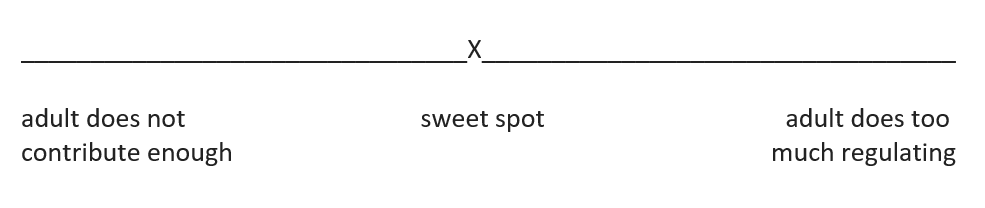
Reflecting on my personal tendencies throughout that post, I explained how and why I think I habitually fell too far towards “adult does too much regulating” as a young adult. By “doing too much regulating”, I mean that, if co-regulation is a shared process wherein both the adult and the child are active participants, I did more than my share of the work. If co-regulation is akin to scaffolding – in the sense that we want to help the child just enough that they can still be active enough in the process to build self-regulatory abilities, then by doing too much, I was removing opportunities for children to practice.
I love using my spectrum of coregulation as a teaching tool. The idea behind it is simple: if you want to end up at a specific destination, like the “sweet spot” of co-regulation, you have to first input your starting location! You have to understand how far you are from the “sweet spot”, and in which direction. For example, if you are too far to the “adult does too much regulating” end of the spectrum, you obviously have to become aware of that as a very first step. As soon as you’re aware, you can catch yourself mid co-regulation and ask yourself ‘am I attuning with this child right now?’ ‘does the child actually need this much help right now?’ ‘what if I turn down my support a little, or tried something gentler, what does it feel like now?’
Part of developing this awareness is understanding how your life experience brought you here, to your current location on the spectrum of coregulation. Why? Because we can use as many landmarks, as many stories, as possible, to help us get a sense of ourselves and our tendencies.
Here’s an easy way to see what I mean – picture a frustrated toddler whose toy grocery cart is stuck on the edge of the carpet. She pushes and grunts to no avail. You say “Your cart is stuck. How frustrating. You can figure it out. Keep trying.” Finally, she shakes the cart back and forth, and the cart is suddenly freed. You come and hold the handle with her for a second. Together you pull the cart backward. You say: “I see what happened, you had to pull the cart backward to get the wheel unstuck.” Realizing what happened, the toddler squats down and grabs the freyed edge of the carpet where the cart was stuck to contribute to the conversation, as they do, in their toddler-hundred-language style.
Bringing our habits to our consciousness is a murky process. The way we do things is a result of how our brain pathways have been routed and carved over time. Our habits become implicit functions of our brain, like the pathways for driving, where you don’t have to consciously tell your hands to move the steering wheel an inch to the right.
If we wanted to change the way we drive (a car or a grocery cart lol), we would first have to start making our habits and tendencies explicit and conscious. We would need to pause, just like you and your toddlers do, have a lil communication, tell each other stories about how we navigate our daily lives, and why we do things that way, and come up with ideas and realizations about how and why we would like to change. “Lately I’m realizing I drive too close to the curb. I think it’s because I’m afraid to drift into oncoming traffic! When I was a teenager I was in a car crash, maybe it has something to do with that.”

I actually received a lot of empathy and tenderness about the “Co-regulation: Reflecting on my own habits” post. People seemed to feel warm and fuzzy about my over-regulating. Being relentless in my pedagogical thoughts, I couldn’t stop thinking about how, in my experience, adults who fall further towards the other end of the spectrum – “adult does not contribute enough” – do not receive the same compassionate regard, and that has always bothered me.
For myself I now realize that in the days of my ‘adult does too much regulating’ tendencies, a crying child would unconsciously remind me of my own un-soothed distress as a child. Then I would – not fully consciously – shift into a powerful nurturing mode, and firehose all my soothing energy at the upset child. It was like, instead of staying attuned to the nuances of the child’s emotional state, I was adding my unprocessed emotions to the mix, and once they were in there, then the situation required all of the soothing and nurturing I could possibly muster. These are my stories, my signposts, that helped me get a sense of myself and bring my interactional habits to consciousness.
For the educator who’s tendency is more towards under-regulating, instead of rushing to an upset child and dramatically whisking them into a coregulatory embrace, she might allow an infant to fuss or cry for a few, or even five long minutes, before attending to him. The origins of the habit might be a little different. To state just one example out of I’m sure an endless number of possibilities, she might have had a caregiver who ‘needed’ her hugs and physical presence in order to regulate their own tumultuous emotions. As an adult, in the interest of preserving some breathing room for herself, her habit might be to leave some space around an emotional interaction. Perfectly reasonable and adaptive response to her upbringing. And still, in the interest of improving her relating with her children, she might decide she wants to get more conscious intention around that tendency now.
As much as capitalist, white supremacist, western society leads us to believe, we are not machines. We can’t just sign off on our yearly CPL reading of the Code of Ethics and Standards of Practice and turn around and ‘automatically implement it’. People don’t go to a two-day workshop, print out their certificate, and show up on Monday, putting brand new things into practice! That’s not how human beings work. Changing tendencies, interactional habits, approaches, and behaviors, is gradual, long-term work. Change does not happen as a result of engaging with research and theory. Yes, research and theory can help us determine the direction we want to go, the ways of being we want to live into. But change happens when we engage in authentic self-reflection, when we unearth our stories and landmark ourselves, in dialogue with ourselves and with one another, which generally doesn’t happen unless we are contained and held down, by caring, understanding, reliable, and supportive, relationships. It is a scary thing to look in the mirror and see new things. We need secure bases the same as our children do.
Although the capitalist workplace is certainly not the primary site for transformational social change, I think that it is possible to do bits and pieces of meaningful transformative work here. In this competitive, individualist, colonial land of the small-family-as-island-unto-itself, I think any and all bridge-building is movement in a healing direction. And I think wherever we manage to cultivate authentic relationships that are able to contain our honest reflections, on our tender vulnerabilities, and our stories about where they came from, we build capacity for transformation.
RE: the work of bringing implicit/unconscious relational habits with children to consciousness, try Shefali Tsabary’s “The Conscious Parent: Transforming Ourselves, Empowering our Children” or Dan Siegel’s “Parenting from the Inside Out: How a Deeper Self-Understanding can Help you Raise Children Who Thrive”. And try Nat Vikitsreth’s Podcast “Come Back to Care”, specifically these episodes: “Are you Regulating or Coping” (on how inner child wounds can complicate our ability to practice regulation), or “How to Raise Change Agents: Lessons from Gaza Solidarity Encampments” (on the connections between re-parenting our inner selves and raising our children to take social justice action), LAST BUT NOT LEAST re: bridge-building and cultivating authentic, deeply caring relationships in the workplace, the work of Ontario Consultant Natalie Royer
 Situating Pedagogy