
Cover photo for this post:
Parents and children at High Park Alternative School [Image]. (N.d.). URL https://schoolweb.tdsb.on.ca/highparkalt/Parents
JESS WOODS, December 19th, 2023
One day this past spring, on my way out of High Park, I ran into a group of school agers headed down a wooded path after a teacher. It was a few days after the 2023 prescribed burn, and there were large swaths of burnt earth either side of the path. A handful of children called up to their teacher: “Hey, why does it look like there’s been a forest fire here? Was this forest on fire too?” (Reasonable questions, given all the smoke in the air the week before, from the widespread wildfires). I stopped and turned around so I could witness the teacher’s handling of this question. His response was something like: Not exactly. The city sets those fires on purpose. The group of children seemed legitimately astonished. “Why?!” a few of them yelled. The teacher went on, something like: This is actually part of how we should be managing forests all over the country – burning parts of them to make a ‘fire break’ which, when an actual forest fire occurs, will slow the spread. Indigenous people always knew about controlled burns and they were way better at managing these things.
As someone who is pretty much obsessed with the piece of land that is ‘High Park’, I was both impressed by this answer and at the same time deeply dissatisfied. On the up side, the answer attempted to acknowledge Indigenous stewardship, and any conversation about the topic of prescribed burning in High Park would be grossly inadequate if it didn’t involve Indigeneity. But it left me wanting more – way more.
Since the early 2000’s, the City of Toronto has applied regular prescribed burning to High Park. The scenes are emblazoned in my mind: the signs posted at the elevators of my Oakmount Road apartment complex, the orange-suited workers, the citrus skies, the plumes of smoke in the air. It is a remarkable thing to behold, giant swaths of one of Turtle Island’s most well- known parks set ablaze. But answering the question Why do they set fire to High Park? in a contextualized and situated way is not easy.
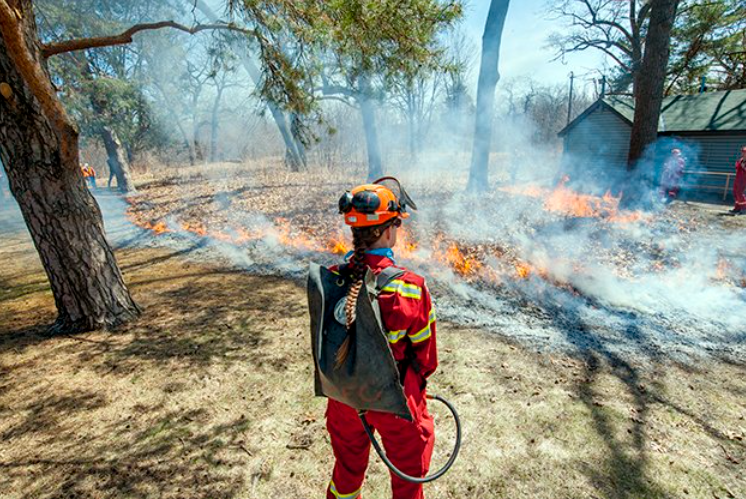
From Photo gallery: High Park goes up in flames. [Image]. (2015, April 16) URL https://nowtoronto.com/news/high-park-goes-up-in-flames/
So-called ‘High Park’ is actually a small, somewhat in-tact piece of Tkaronto’s original oak savannahs, networked ecosystems that were carefully maintained for an estimated at least 10,000 years by different Indigenous Nations who made their home in Tkaronto area including (but not limited to) the Wendat, Haudenosaunee, Anishinaabe, including the Mississauga’s of the Credit River, under the Dish with One Spoon treaty (Becoming Sensor, N.d., Johnson, 2023; Doiron, 2023).
A savannah is a type of microclimate that typically contains a variety of tall grasses, many special plants and wildflowers, and a few small trees and bushes. Unlike a sun-drenched prairie, a savannah’s grassy fields dance in a dappled sun-shade created by the ‘structure’ overhead — the relatively few mature and fire-resistant trees, behemoths that have survived a century or more. In High Park’s case, these are mostly black oaks.
Half-prairie and half-forest, a savannah is a transitional ecosystem, always moving away from being a grassland and towards becoming a forest, as the trees and bushes seed themselves forward and fill in the grassy parts over time. But, when it is carefully sculpted with controlled burning, it can continue to be its hybrid self. ❤️ So one of the specialest things about a savannah is, for it to even exist, savannahs and humans must be in active, attuned relationship ❤️
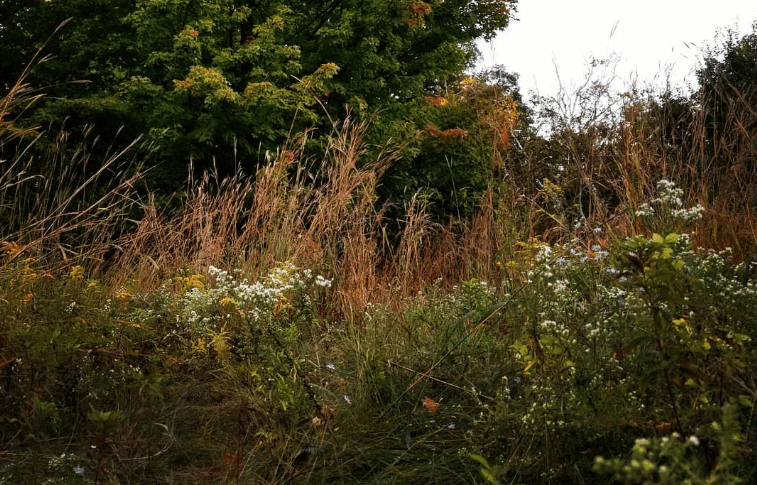
As Indigenous peoples consistently applied controlled burning to the piece of land that is now known as High Park for over 150 generations, the High Park oaks evolved their leaves to curl more easily, so that the fallen ones could facilitate the spread of a low-burning fire. The fires cleared away ground debris, helping the acorns reach the soil (City of Toronto, N.d.). Burning also protected and sustained the many rare berry bushes, the delicate but dazzlingly showy blazing star, bright orange butterfly milkweed, sky blue aster, and the different tall grasses that grew in the savannah. Indigenous peoples knew (and many still know) the special and beautiful properties of each one. Many of the original savannah plants, which you can look up here, still thrive in the park today, and have survived due directly to thousands of years of highly skillful Indigenous stewardship (Johnson, R., 2020; High Park Nature, N.d.) and Indigenous peoples’ drive to sustain relationship with the land, despite the horrors of colonization.

Under colonial rule, intentional fires were outlawed and suppressed. In 1836, the park and surrounding area was bought by John Howard, an extremely wealthy colonizer with a ridiculous amount of imperial power. He and his wife Jemima lived there for their time together, then ‘donated’ it to the city of toronto after that (High Park Nature, N.d.b). Predictably, neither Howard, nor the city seemed to have much interest in learning how to understand or maintain the savannahs. Tkaronto-area Indigenous people were and continue to be denied stewardship of the places and spaces they sustained with reciprocal, regenerative relationships for many thousands of years.
Today, Indigenous organizing and ongoing knowledge-keeping around stewardship of the savannahs and surrounding area is going strong, and poised to turn the tables back around in High Park. One place where the knowledge of how to steward GTA’s oak savannahs is kept alive is in the Toronto group called the “Indigenous Land Stewardship Circle” (Indigenous Land, N.d.). The Stewardship Circle is currently advocating to assume ultimate direction over the care and management of the park. Holding the knowledge applied in stewarding GTA-area oak savannahs for approximately ten thousand years, the group is gaining traction.
Recently, the Indigenous Land Stewardship Circle has called for a complete ban on pesticide use in High Park. For the city of Toronto, pesticides have been a primary tool in managing invasive species -plants that are not indigenous to Tkaronto or the savannahs and who may crowd out indigenous species or change the soil conditions in ways which make it more difficult for these native plants to thrive. But for the elders of the Land Stewardship Circle, pesticides are never the answer. They are obvious toxins to the soil, streams and ponds. They poison and weaken the fungus, insects, fish, birds, and human adults and children who frequent the park. What’s more, say Indigenous stewards, invasive plants themselves are not the problem. They only spread and take up space where ecological conditions are out of balance. Spraying pesticides only exacerbates the problem by pushing the environment further out of balance. In their words:
“Non-native plants thrive here only because of ongoing processes of colonization. Chemical management cannot erase the damage done by colonization; it only compounds it, adding to the destructive forces of over a hundred and fifty years of colonial land management that has led to ecological destruction and the dispossession of Indigenous peoples in this region.” (ILSC, 2019b).
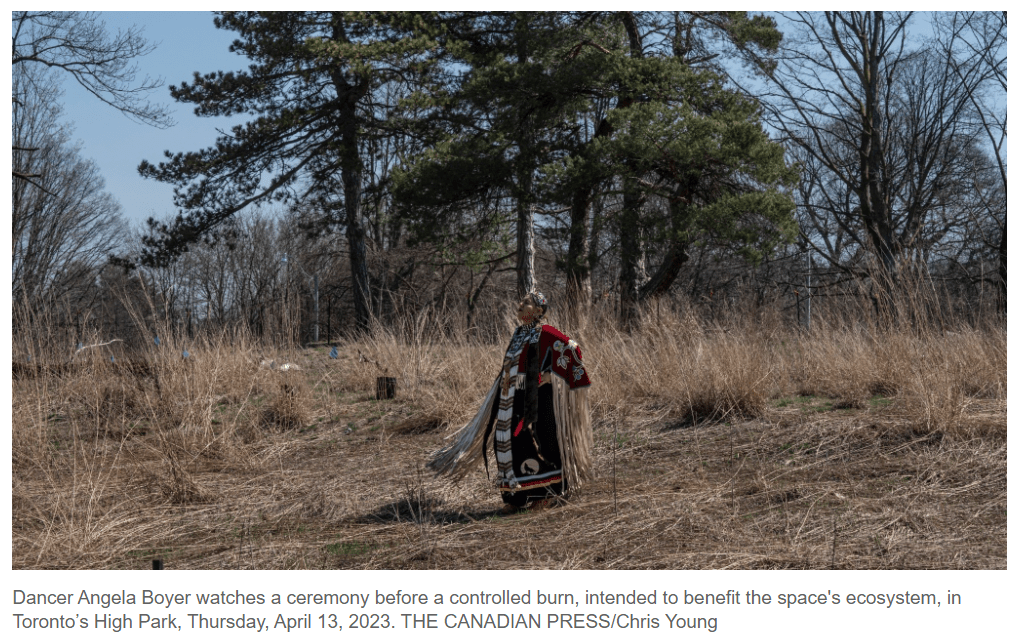
The Indigenous Land Stewardship Circle’s advocacy is also focused on guiding the city on its protocols for prescribed burning. This year, 2023, was a monumental year for the Stewardship Circle, as their iterative and persistent efforts to educate and partner with the city broke through yet another layer, deepening their influence on park management. This year, for the first time in almost two centuries, Indigenous stewards ceremonially led and oversaw the burnings, like they had done, right there on that very piece of land, for the estimated 38 centuries previous to that.
That’s right, those very same burn marks that the school agers were asking about were made by Indigenous-led fires. For the first time in centuries. This year. You can see a video clip of this story here.
And so now you’re starting to understand my disappointment in the answer that teacher gave those school agers. I’ll share more in Part 2.
From CTV News (referenced below as DeClerq and Lavoie, 2023):
all unreferenced photos are courtesy of the author
This post contains a large amount of historical information which I have cobbled together through research and conversation. If you have any corrections or edits to share, I would be very grateful if you would email me at yesjesswoods@gmail.com
References
Alderville Black Oak Savannah. (2018). Ecological Restoration. https://www.aldervillesavanna.ca/index.php/mandate/
Becoming Sensor. (N.d.) High Park’s Oak Savannahs. Retrieved from https://becomingsensor.com/high-parks-oak-savannahs/
DeClerq, K. (2023, June 18). Most of Ontario remains under fire bans as 3 times as many wildfires reported in 2023. CP24 https://www.cp24.com/news/most-of-ontario-remains-under-fire-bans-with-3-times-as-many-wildfires-reported-in-2023-1.6445962?cache=zlgpr
DeClerq, K., and Lavoie, J. (2023, April 13). Toronto’s High Park underwent a controlled fire. This is what it looked like. CTV News. https://toronto.ctvnews.ca/toronto-s-high-park-underwent-a-controlled-fire-this-is-what-it-looked-like-1.6353617
Doiron, G. (2023). Invasive Plant Relations in a Global Pandemic: Caring for a “Problematic Pesto” 1. Environment and Planning. E, Nature and Space (Print), 6(1), 600–616. https://doi.org/10.1177/25148486211066109
High Park Nature. (N.d.) Prescribed Burns in High Park. Retrieved from https://highparknature.org/article/prescribed-burns-in-high-park/#history-of-high-park-prescribed-burns
High Park Nature. (N.d.b) John and Jemima Howard. Retrieved from https://highparknature.org/article/john-and-jemima-howard/
High Park Stewards and High Park Community Advisory Council. (2008). Rare Plants of the Endangered High Park Black Oak Savannah. https://highparknature.org/wp-content/uploads/2021/07/Rare-Plants-Guidebook-PDF.pdf
Indigenous Education Network. (2020, December 3) Lunch and Learn Dish with One Spoon Wampum with Rick Hill Sr. [Video] YouTube. https://www.youtube.com/watch?v=SiU5uvGXhxA
Indigenous Land Stewardship Circle. (N.d.) Restoring Indigenous stewardship to tkarontos ancient oak savannahs. https://indigenouslandstewardshipto.wordpress.com/
Indigenous Land Stewardship Circle (ILSC) (2019b) ILSC Calls for a complete ban on pesticide Use in High Park: Indigenous Stewardship is Climate Action and Harm Reduction. December 18. Available at : https://indigenouslandstewardshipto.wordpress.com/ilsc-calls-for-a-complete-ban-on-pesticide-use-in-high-park-indigenous-stewardship-is-climate-action-and-harm-reduction/
Johnson, J. (2013). The Indigenous Environmental History of Toronto, “The Meeting Place”. In L. A. Sandberg, S. Bocking, & K. Cruikshank (Eds.), Urban Explorations: Environmental Histories of the Toronto Region (pp. 59– 71). Ontario: Wilson Institute for Canadian History.
Johnson, R. (2020, February 15). ‘Its very precious’: Indigenous collective wants input into managing High Park’s Oak Savannah. CBC News. https://www.cbc.ca/news/indigenous/high-park-indigenous-land-stewardship-1.5456265
John George Howard. (2023, November 7). In Wikipedia.
https://en.wikipedia.org/wiki/John_George_Howard
Kidd, Christensen & McEwen. (2000). High Park: Restoring a Jewel of Toronto’s Park System. https://highparknature.org/wp-content/uploads/2018/12/High%20Park%20Restoring%20a%20Jewel%20of%20Toronto%E2%80%99s%20Park%20System.pdf
Local Love Magazine. (2018, November 5). Land acknowledgements: uncovering an oral history of Tkaronto. [Video]. YouTube. https://www.youtube.com/watch?v=voXySM-knRc
Russell, V. (2015). John George Howard. In The Canadian Encyclopedia. Retrieved from https://www.thecanadianencyclopedia.ca/en/article/john-george-howard
Taiaiako’n Preservation Society. (n.d.). WordPress. https://taiaiakon.wordpress.com/
Tupman, K. (2010, May-June). Fire restores a rare forest: black oak savannah. Grand Actions: The Grand Strategy Newsletter, 15 (3). https://www.grandriver.ca/en/learn-get-involved/resources/Documents/Grand_Actions/Publications_GA_2010_3_MayJun.pdf
 Situating Pedagogy