
November 20, 2023
As you read the following case study, I invite you to stay present in your body as you imagine yourself in this situation. Instead of mapping ideas that “we know”, or “have learned” onto this case study – instead of engaging in a rational process of deciphering what the main character “should do” – let’s stay present in our bodies and ask ourselves honestly what we ourselves would do, or what our body wants to do when imagining ourselves in the situation.
OK, ready? What does your body want to do? How does your body tell you to move? What’s your instinct?
Scenario: Jayvion
It is mid-morning in your infant room. You are filling out daily charts at the counter. Working in the room with you are two of your coworkers. One is holding two infants and singing. Another is soothing someone in the sleep room. One of your other infants, Jayvion – starts to quietly cry. You easily recognize that it makes the most sense for you to go and co-regulate with the crying Jayvion. Jayvion’s whimpers began gradually and the volume is steadily increasing. You look over and see that his soother is no longer in his crying mouth, his back is starting to arch, and his head is turned to the side.
When we as educators feel safe and strong enough to do this exercise with integrity, as we walk ourselves through the scenario we might realize that our habit energy feels most comfortable leaving the child to cry for a while. Or, we may realize our main instinct is to rush to the child right away and scoop them up into a coregulatory embrace.
Let’s take a moment to revisit coregulation. In coregulation, each party is meant to be active in the process – the educator offers a soother, the child sucks, the educator sings a gentle song, the child follows the melody, etc. In all ongoing processes of co-regulation, whether the child is 8 months or 8 years, the goal over time is to gradually decrease the amount of work that we the adults do and gradually hand more and more of the responsibility for self-soothing over to the child; as their brain pathways for “coming back to centre” strengthen – gradually and at their own pace – over time.
For me, in coregulation, like in scaffolding, we are looking for the exact edge where the child can stretch themself to play as active a role as possible in the process. We don’t want to do more than the child is actually requiring, because we want to make use of all opportunities for them to actively practice regulating themselves. I like how it is worded and graphed in this “Practice Brief” which is a collaboration of the University of North Carolina and Duke Center for Child and Family Policy:
“As a child’s ability to self-regulate increases, less caregiver co-regulation is required. For an infant, co-regulation support will encompass a large proportion of regulatory needs: babies need caregivers to feed them when they are hungry, help them sleep when they are tired, and give cuddles when they are overwhelmed. An older youth, on the other hand, may only need co-regulation support during complex life transitions or when emotionally overwhelmed.” (Rosanbalm & Murray, 2017).
Figure 1

Note. This graph suggests how caregiver co-regulation decreases over time as a child ages. From: “Caregiver Co-regulation Across Development: A Practice Brief” by K.D. Rosenbalm and D.W. Murray, 2017, Office of Planning, Research, and Evaluation, Administration for Children and Families, US. Department of Health and Human Services.
Applying this reasoning to the Jayvion scenario, maybe (this is just my current wondering) maybe the wisest practice1 in the moment would be to respond to his initial cry with our voice, saying the child’s name and conveying empathy: “Jayvion – Jayvion sounds upset; I’m coming love.” And then – maybe right away, and maybe after a quick moment or two – moving towards Jayvion while continuing to soothe him with our words. Squatting down to him, we might notice his soother’s fallen out, and he’s thrashing his head a bit, as if trying to find it with his cheek. In a split second, we might attune to him – body to body – and assess the nature of his cry, his breathing, his skin – is he hot? How upset is he? In what way is he upset (what does my body tell me?) And then – maybe – our first guess is just that his soother’s fallen out. So instead of just popping it back in, we take his little arm and gently help direct it – touch his little hand to the soother, sitting in the crook of his neck. And as Jayvion grabs it, we may sort of, help it back into his mouth.
If Jayvion settles immediately, we’ll go on, in our soothing tone, “There, you got it. Look at you, you found your soother. You got it.” And we might wipe his little tears away and stay with him, squatting, while we answer a random question that our co-worker directs our way. And seeing that Javion is well on his way back to calm, we might stay for a little joke, or a little peek-a-boo, or respond to his little communications (making the same face back, clasping his hand as he reaches for ours). And then head back to quickly finish up our charts.
I remember when I first started to reflect in more nuanced ways about my own practices of coregulation. One clear memory I have is of watching a video from the RIRO training (Reaching In, Reaching Out). In the video, a child escalates emotionally when she can’t have a certain toy, because someone else is using it. I remember the educator – who was sitting in a chair and already at the child’s eye level – confidently reach her hand towards the child and say something stabilizing and orienting. I think she just put words to what was happening for the child – something like “You want that really bad. But so-and-so is playing with it right now.” The child placed her hand inside of the educator’s, blinked a couple of times, and nodded. Even though she had seemed close to a complete meltdown 5 seconds earlier, she was able to deescalate herself pretty smoothly. All the educator did was be calm, validate the child’s experience, and offer one hand.
In the middle of watching this video I suddenly realized that my ‘co-regulatory habit’ was to over-soothe. If it had been me in the video, I would have actively drawn the child towards me and sat her on my knee. I would have rubbed her back. And it probably would have worked out fine on the surface. But that video showed me that I was habitually going further than was necessary. That in the dance of coregulation, I was regularly ‘pulling more than my weight’; removing opportunities for children to actively practice regulating. With this habit, I was inadvertently disempowering children and unintentionally encouraging them to remain passive in dealing with their emotions. At times, I was likely co-regulating with children more intensively than they would have invited or even desired. If I had been the educator in the RIRO video, pulling the child into my lap at that exact moment would have removed her from the tense social situation of being angry about not having the toy. Scooping her into my lap would be like offering her the option to jump down an ‘escape hatch’ – and also thus removing the opportunity to build some “social distress tolerance!” I mean there’s so much going on in how a single coregulatory moment is approached.
As I’ve continued to monitor and witness myself co-regulating over the years, I’ve realized that my own felt sense of children’s emotional distress is usually more intense than it actually is for the child. I’ll word it like this – If I’m not careful and don’t keep conscious awareness of what’s happening in my body and mind2, I can misinterpret children’s cues. The feelings of empathetic distress that get activated in my own body are so strong and so loud that I can’t properly attune to the nuances of what’s going on for the child. Like many of us, I am a human being who didn’t receive enough co-regulation as a child. I don’t know if my felt sense of children’s distress is a body-memory of mine, if it’s backed-up emotion that still needs to come out, or if I’m trying to make up for what I didn’t get by over-doing it for all of the children I love, but any way you slice it, it is a fact that my tendency is to fall on the over-soothing end of the spectrum.

So for me, back then, given the Jayvion scenario, I would be the ECE running or at least run-walking immediately to Jayvion, undoubtedly adding unneeded tension and urgency to the emotional atmosphere. I probably would have scooped him up, popped his soother immediately back in his mouth and jiggled him up and down before he even knew what was happening.
But I believe infants deserve a chance to notice their feelings, to have us make it all make sense for them (“you’re sad and frustrated, you can’t reach your soother”) and they also deserve the chance to exercise their own agency and play a part in their own regulation (“here it is, here’s your soother over here, can you reach it now, can you get it? There you go.”). I believe they need a certain amount of pacing and space around an interaction in order to practice experiencing their own physiological reactions and responses.
Sometimes when I’m teaching, I have people imagine co-regulation on a spectrum like this:
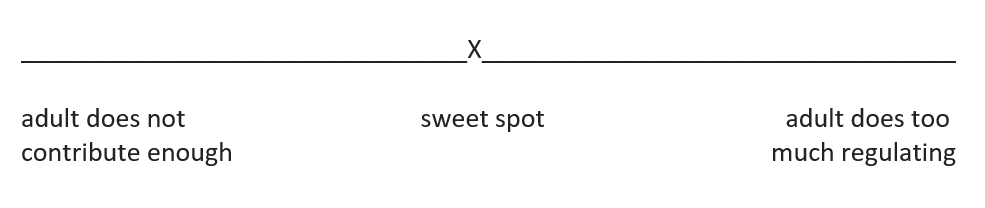
I had already completed a 4 year undergraduate degree in Child Studies and been a practicing ECE for 8 or 9 years when I finally had those initial realizations while watching that RIRO video, and I can still remember them viscerally. (In a cold room on the first floor of that giant red brick church on the NW corner of College and Bathurst – in the dark, on a Friday, where I was the RIRO trainer, holding a clicker and sitting at a particleboard table while church members were setting up a Valentines Day craft sale in the lit up hallway). It was kind of a mind-blowing moment for me. For the first time, I could consciously situate myself – “adult does too much regulating”.
Footnotes
1Here I’m thinking of Joy Goodfellow’s use of the term “wise practice” as she calls for us to “move beyond `best’ practice and explore the concept of `wise’ practice. The basic premise for a move is that `wise’ practices are always contextually located and enacted by knowledgeable, thoughtful, and sensitive professionals who are attuned to each child’s emotional wellbeing.” (Goodfellow, 2001). I imagine that the ECE in the Jayvion scenario is drawing upon the context – Jayvion’s family’s current life and emotional circumstances, his physiological well-being, and even his mood today – to guide their discernment of how much of the regulation process they will encourage him to take on in this moment.
2My favorite framework for thinking about this is Dan Siegel’s “Wheel of Awareness”, where he encourages us to stay in the “hub” of awareness and remain aware of our mental activities and bodily sensations.
References
All uncited images are courtesy of the author
Goodfellow, J. (2001). Wise practice: The need to move beyond best practice in
early childhood education. Australian Journal of Early Childhood, 26 (3).
Rosanbalm, K.D., & Murray, D.W. (2017). Caregiver Co-regulation Across
Development: A Practice Brief. OPRE Brief #2017-80. Washington, DC: Office of Planning, Research, and Evaluation, Administration for Children and Families, US. Department of Health and Human Services. https://journals.sagepub.com/doi/10.1177/183693910102600302
Siegel, D. (2018, August 21). The Wheel of Awareness. Garrison Institute
 Situating Pedagogy